
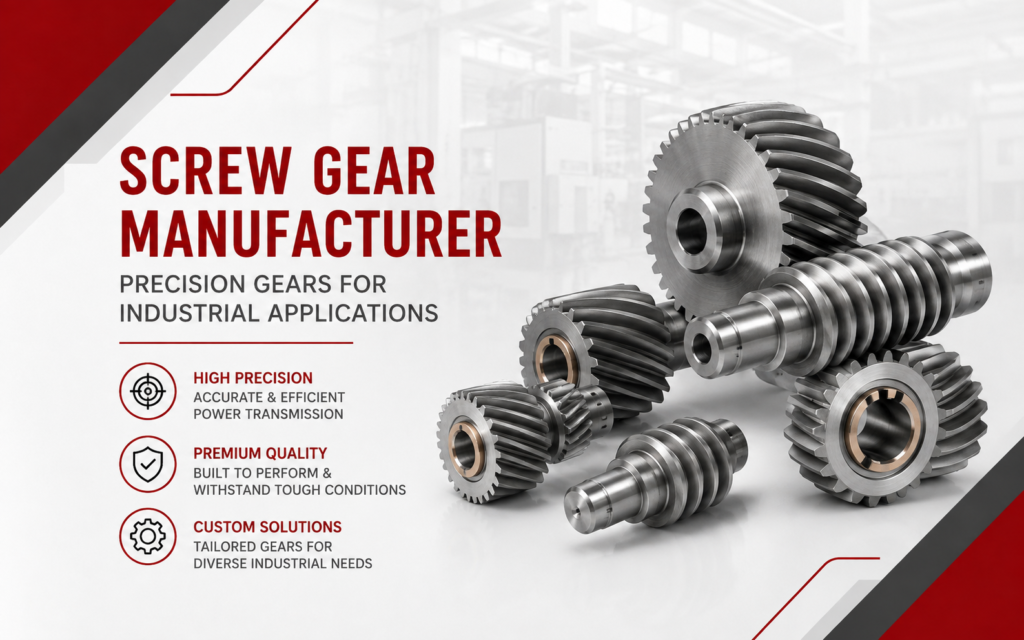
Screw gears, also known as crossed helical gears, are widely used in industrial machinery where efficient, reliable, and smooth power transmission is required. The quality of gear design plays an important role in determining efficiency, service life, operating noise, and maintenance requirements in equipment such as material handling systems, automation machinery, conveyors, and industrial drives.
For businesses looking for reliable and application-specific gearing solutions, choosing an experienced Screw Gear Manufacturer in Mumbai, India can make a significant difference. An experienced manufacturer can develop gears according to specific operating conditions, dimensions, load requirements, speed, and performance expectations.
What is a Screw Gear?
Screw gears generally refer to crossed helical gears. These are cylindrical gears with helical teeth designed to transmit motion between two shafts that are neither parallel nor intersecting. They are particularly useful when power needs to be transmitted between shafts positioned at an angle, including applications where compact and smooth transmission is required.
The helical tooth design allows gradual engagement between mating gears, which can contribute to smoother and quieter operation compared with some other gear arrangements. This makes screw gears suitable for machinery where reduced noise, compact construction, and consistent motion are important.
Key Characteristics of Screw Gears
- Helical tooth profile
- Suitable for angled shaft arrangements
- Smooth and quiet operation
- Compact transmission design
- Available in different sizes and materials
- Suitable for customized industrial applications
Uses of Screw Gears
Screw gears are used across a wide range of industries and industrial equipment. Their ability to transmit motion between angled shafts makes them suitable for various specialized applications.
Automation and Machine Tools
Screw gears can be used in automated machinery and machine tools where controlled and consistent movement is required.
Packaging Machinery
Packaging equipment often requires compact and reliable power transmission systems. Screw gears can support smooth operation in such machinery.
Material Handling Equipment
Conveyors and other material handling systems may use screw gears where angled power transmission and compact arrangements are required.
Printing Machinery
Printing equipment requires precise and consistent movement. Properly manufactured screw gears can contribute to reliable mechanical transmission.
Textile Machinery
Textile machines operate continuously and require dependable mechanical components. Screw gears can be incorporated into selected transmission applications.
Industrial Drives
Screw gears are also suitable for various industrial drive systems where shaft positioning and space limitations influence gear selection.
Special-Purpose Machinery
Custom-designed screw gears can be manufactured for machinery with specific dimensional, load, speed, or installation requirements.
The specifications of screw gears can vary from one application to another. Factors such as shaft arrangement, operating load, rotational speed, available space, tooth geometry, and required service life should be considered during the design stage
Importance of Accuracy in Screw Gear Design
Precision is essential when designing and manufacturing screw gears. Even a small error in tooth geometry, dimensions, alignment, or surface finish can affect gear performance.
Precision Tooth Profile
Accurate tooth geometry helps ensure proper engagement between mating gears. An incorrect tooth profile can increase friction, vibration, and wear.
Dimensional Accuracy
Maintaining accurate dimensions is important for proper installation and alignment within the machinery. Consistent manufacturing tolerances can help improve overall gear performance.
Material Selection
The material used for manufacturing a screw gear should be selected according to the operating environment, load, speed, wear requirements, and expected service life.
Surface Finish
An appropriate surface finish can reduce friction and support smoother interaction between mating components.
Quality Inspection
Experienced manufacturers use inspection procedures throughout the manufacturing process to identify dimensional or manufacturing deviations before the component reaches the customer.
High-quality screw gears can provide several benefits to industrial machinery when correctly designed and manufactured.
Smooth Power Transmission
The helical tooth arrangement allows gradual tooth engagement, supporting smooth transmission of rotational motion between the shafts.
Reduced Noise and Vibration
Properly manufactured gears with accurate tooth geometry and suitable finishing can help minimize unnecessary noise and vibration during operation.
Compact Transmission
Screw gears can be useful where machinery has space limitations or requires power transmission between shafts positioned at an angle.
Operating Flexibility
Different tooth configurations, dimensions, materials, and manufacturing specifications allow screw gears to be adapted to various mechanical requirements.
Reliability and Consistent Performance
Precision manufacturing and appropriate material selection can improve durability and help gears deliver consistent performance over their intended operating life.
Mumbai is one of India’s major industrial and engineering centres, with manufacturers and suppliers serving a wide range of machinery and engineering sectors. However, choosing the right manufacturer should involve more than simply comparing prices.
Businesses looking for a Screw Gear Manufacturer in Mumbai, India should consider several important factors.
Experience in Gear Manufacturing
Look for a manufacturer with practical experience in producing industrial gears for different applications. Experience can help the manufacturer understand application-specific requirements.
Design and Engineering Capabilities
A capable manufacturer should be able to evaluate gear dimensions, shaft arrangements, load conditions, speed, and other technical requirements before production.
Material Availability
The manufacturer should have access to suitable materials based on the application’s strength, wear, and operating requirements.
Gear Tolerance and Accuracy
Ask about manufacturing tolerances and inspection procedures. Precision is particularly important for gears used in demanding industrial applications.
Quality Control Procedures
A systematic quality-control process can help identify dimensional, tooth-profile, and surface-finish issues before delivery.
Customization Capability
If standard gear dimensions do not suit the application, the manufacturer should have the ability to produce customized gears according to technical drawings and specifications.
Manufacturing Capacity
Consider the manufacturer’s production capabilities, equipment, capacity, and ability to meet the required quantity and delivery schedule.
Technical Support
Professional assistance from experienced engineers or technicians can be valuable when selecting specifications or developing a gear for a specific machine.
By working directly with an experienced manufacturer, businesses can communicate their operating conditions and technical requirements more effectively. This helps ensure that the finished gear is designed according to the application’s load, speed, dimensions, and performance expectations.
Industrial machinery often requires components with specific dimensions and technical characteristics that may not be available as standard products. In such cases, custom screw gear manufacturing can provide a suitable solution.
Customized Gear Specifications
A manufacturer can produce screw gears according to requirements such as:
- Tooth pitch
- Helix angle
- Gear diameter
- Number of teeth
- Bore diameter
- Face width
- Material specification
- Shaft configuration
- Surface finish
- Required dimensional tolerances
Custom manufacturing allows the gear to be developed according to the actual machine configuration rather than forcing a standard component into an unsuitable application.
Benefits of Custom Manufacturing
Customized screw gears can help improve compatibility with existing machinery, optimize available installation space, and address specific load or speed requirements. They can also be useful when replacement gears need to match an existing mechanical system.
Importance of Quality Control and Testing
Quality control is an essential part of screw gear manufacturing. Each component should be inspected and verified against the required specifications before it is supplied to the end user.
Dimensional Inspection
Dimensional inspection verifies critical measurements such as gear diameter, bore size, face width, and other specified dimensions.
Tooth Profile Inspection
The tooth profile should be checked to ensure that it conforms to the required design specifications and supports proper meshing.
Surface and Finish Inspection
Surface condition and finish can influence friction, wear, and operating performance. Appropriate inspection helps identify manufacturing defects.
Final Quality Verification
Final inspection provides an additional check before the finished screw gear is dispatched. This helps ensure that the component meets the required technical and dimensional standards.
Small deviations in gear dimensions or tooth geometry can influence the efficiency and performance of the complete transmission system. Therefore, systematic inspection should be an important part of the manufacturing process.
Conclusion
Screw gears are valuable components for industrial applications requiring smooth, compact, and reliable power transmission between angled shafts. Their performance depends heavily on accurate design, suitable material selection, precise manufacturing, and effective quality control.
For businesses seeking a Screw Gear Manufacturer in Mumbai, India, it is important to evaluate technical expertise, manufacturing capabilities, customization options, quality-control procedures, and delivery capabilities rather than focusing only on cost.
A reliable manufacturer can help develop screw gears according to the specific requirements of automation systems, packaging machinery, material handling equipment, conveyors, textile machinery, industrial drives, and other specialized applications. With the right manufacturing partner, businesses can obtain precision-engineered screw gears designed to support dependable and consistent machine performance.